Your Cart is Empty


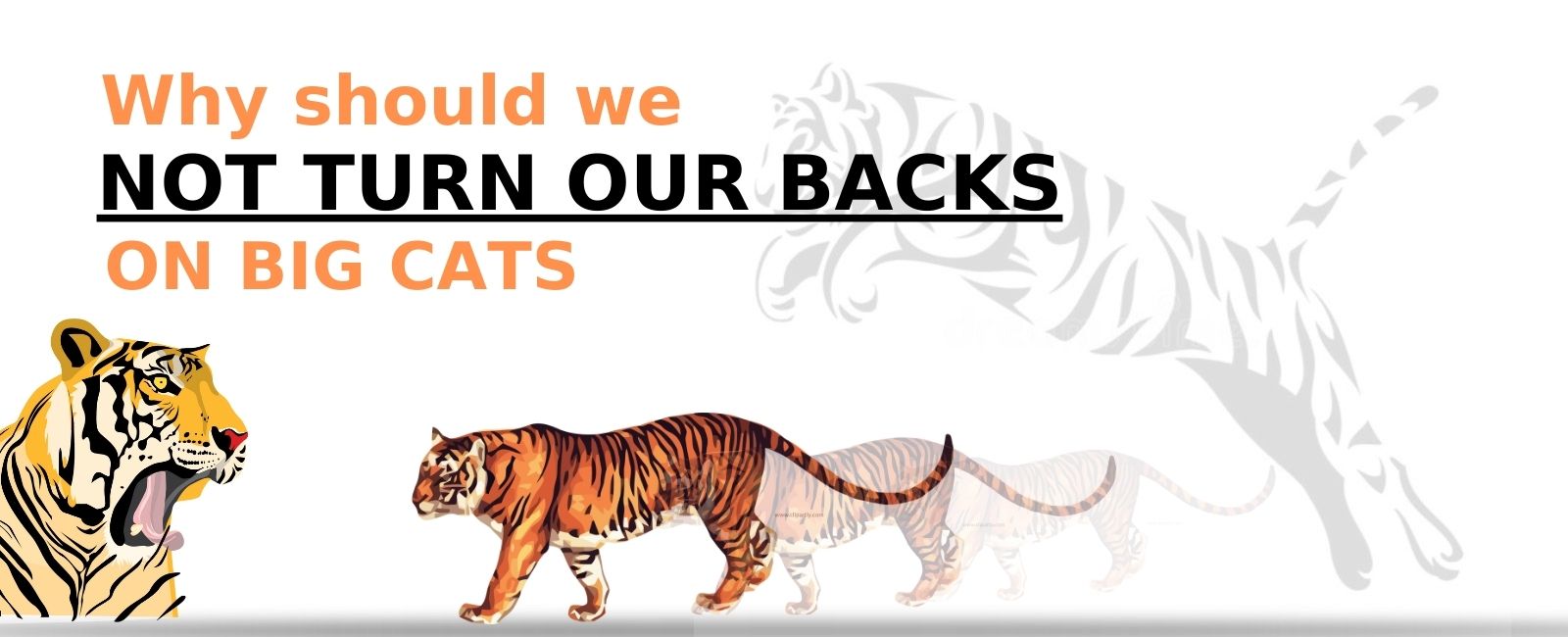

You should never turn your back on a big cat because tigers, lions, leopards and their relatives are ambush predators: they prefer to attack from behind, where the prey cannot see them coming. A person who turns away, or worse, turns and runs, suddenly looks like prey that has been taken by surprise, and that can trigger an attack in an instant. Facing the animal keeps you out of the situation its whole hunting style is built for.
A tiger does not win by chasing its prey over long distances. It stalks, keeping low and hidden in grass or forest cover, creeps as close as it can, and then covers the last few yards in a short, explosive rush. The aim is to reach the prey before it can react. Lions, leopards, jaguars and cougars all hunt on the same principle, even if the details differ from one species to another.
That strategy depends on surprise. Once the prey has spotted the cat and is watching it, the odds change: the animal can dodge, kick, flee or fight back, and a hunter that relies on a single sudden rush has lost its main advantage. If you want to see the whole sequence step by step, our article on how a tiger hunts its prey follows a hunt from the first stalk to the final strike.
All cats prefer to attack from behind or from the side, and the same rule holds for most predators. The reason is simple: an attack from behind is easier and far less dangerous for the hunter. A prey animal that is facing its attacker can see where the blow is coming from and can defend itself with horns, hooves, teeth or claws. Even a strong predator risks injury in a head-on fight, and for a wild animal, an injury can mean it can no longer hunt.
So the tiger avoids frontal attacks. It may face an opponent head-on when there is no other choice, for example when it is defending its cubs or its own life is in danger, but in ordinary hunting it looks for the back or the flank. From there it typically brings the prey down and then bites at the neck or throat. Our guide to how a tiger attacks its prey explains the technique in detail.
This is also why turning your back can instantly trigger the predatory instinct of a tiger or a lion. To the animal, a turned back is the opening it has been waiting for. Running away makes it worse, because a fleeing shape is exactly what a predator is wired to chase, and no person can outrun a tiger.
People who share their land with tigers have known this for a long time. In the Sundarbans, the vast mangrove forest on the coast of India and Bangladesh, tigers have long attacked the people who go into the forest to gather honey, cut wood or fish.
In 1986, forest workers on the Indian side began wearing masks on the back of their heads, painted with a human face. The idea was that a tiger approaching from behind would think it had been seen and would hold back. For a while the trick appeared to work, but the practice soon fell out of use, as tigers reportedly caught on. The experiment says a lot about how tigers hunt, and also about how quickly they learn. If you are curious about that side of the animal, read how intelligent tigers are.
Encounters with wild big cats are rare, and most of them end with the cat slipping away. Still, the advice given by wildlife authorities where people live alongside cougars, leopards and tigers follows the same logic as everything above:
Even smaller prey animals sometimes survive an encounter by turning to face a tiger instead of fleeing. Many tigers hesitate once they know they have been spotted, and some are easily intimidated. A tiger is formidable when it ambushes from behind or from the side, much less so from the front. So the rule is simple: face it, and do not run.
None of this makes big cats villains. People are not their usual prey, and most big cats avoid humans altogether. Trouble tends to come where forests shrink, wild prey runs short, and people and cats are pushed into the same spaces. Understanding why a tiger reacts to a turned back is part of respecting it as the predator it is, in the wild and in captivity alike.
Of course, there are tigers you can safely ignore while you make your coffee. A painted one on the wall, like those in our tiger canvas collection, will keep its eyes on the room whichever way you face. And the roaring, prowling and pouncing tigers in the tiger figurine collection freeze the hunter in exactly the moment described above, minus the risk.