Your Cart is Empty


A tiger tapestry dresses a wall in fabric rather than a frame, and its size gives the animal room to spread out: a tiger lying in the snow with its fangs bared, three tigers bounding through a winter field, a tiger head wreathed in lotus flowers. The hangings in this collection range from photographic scenes to boldly illustrated designs on black, in sizes that start at 150x100cm and reach 180x230cm.
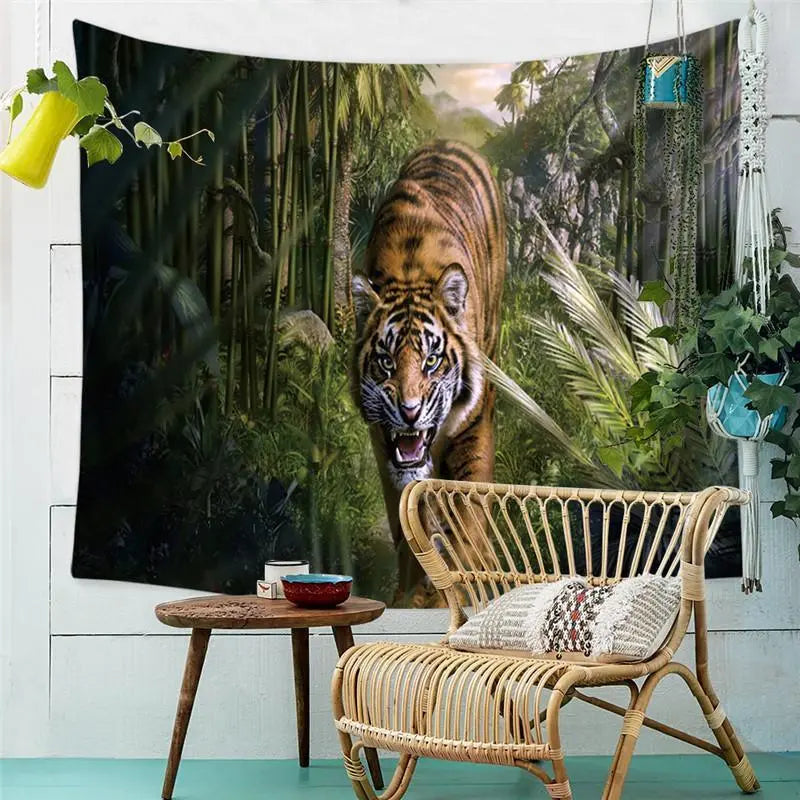
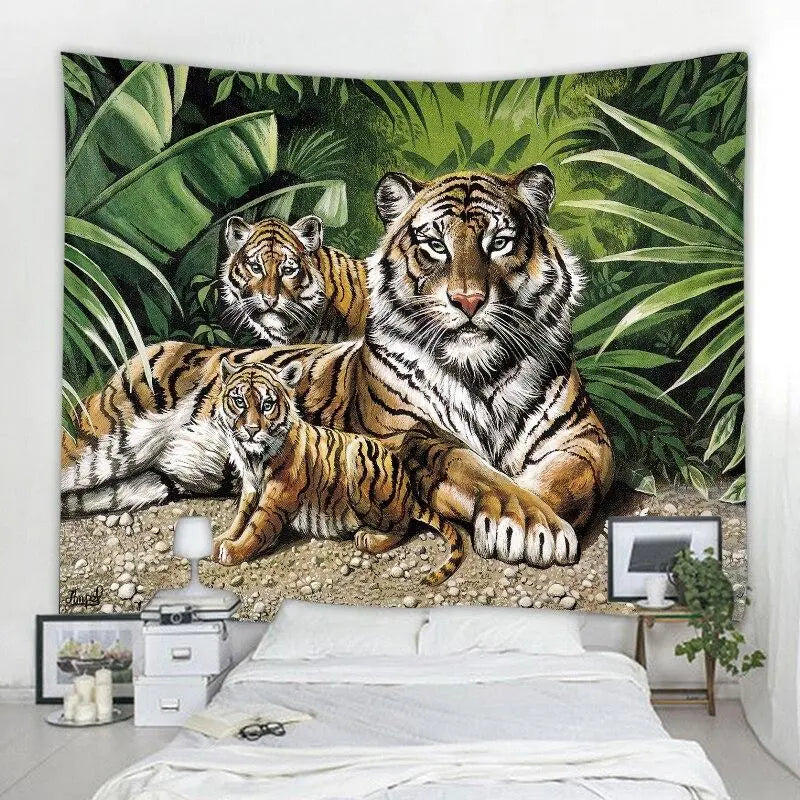
A tapestry hangs from its top edge, so the picture sits softly on the wall with a gentle drape at the sides, as the product photos show. One hanging covers an area that would take several framed pictures, and in the photographic designs the tiger fills almost the whole surface, from edge to edge. That scale is the point: at full size, a tiger's face can be larger than life.
Some designs set an illustrated tiger against deep black, which makes the colors glow. The Tiger Tapestry Yin and Yang shows a white tiger with its eyes closed, its head resting above crossed forelegs, inside a round medallion with a lacy white border. One half of the animal is washed in warm yellow and orange beside a small sun, the other in cool blue beside a crescent moon, and a yin and yang symbol marks its forehead.
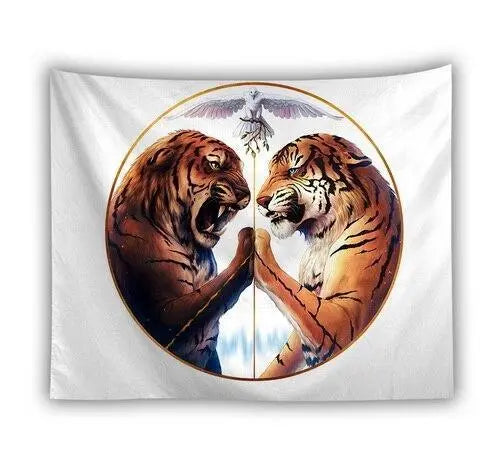
The Tiger Tapestry 2 Brothers uses a similar black field with a thin gold circle split down the middle. Two tigers face each other across the line, paw pressed to paw, one roaring with its fangs bared and the other calm, with a pale blue eye. It reads like a reflection that has come to life with a mind of its own.
Other designs pair the tiger with plants. On the Tiger Floral Wall Tapestry, a blue and white tiger head with green eyes looks out from a ring of pink lotus flowers and broad green lily pads, a small golden lotus mark on its brow, and the product photo shows it hanging in portrait orientation. The Cherry Japanese Tree Tiger Tapestry has a painted feel, with two tigers standing on pale rocks among pink blossoms and red-orange leaves, all on a soft cream background.
Japan has a long fondness for the tiger in art, even though no wild tigers live there. Painters of earlier centuries mostly knew the animal from Chinese paintings and imported skins, which gave many classic Japanese tigers their dreamlike look. Our article on why the tiger is so popular in Japan looks at what the animal came to symbolize there, along with the legend of the White Tiger.
For a lifelike look, the photographic designs bring the animal in close. The Siberian Tiger Family Tapestry captures three tigers running through deep snow straight toward the viewer, snow spraying from their paws against a gray winter backdrop. Another shows a single tiger lying in the snow with its mouth open, every whisker sharp against the white. Elsewhere in the collection, the titles cover sleeping tigers, cubs, a golden tiger, a white tiger and a night scene, along with Chinese and Asian designs.
Tigers have a long history in textiles. In Tibet, rugs woven with tiger stripes or in the shape of a whole tiger skin are said to have been used by lamas for meditation, and old examples are prized by collectors today. The hangings here are made for the wall rather than the floor, yet they carry on the same idea of the tiger as an image to live with. Our article on the Tibetan tiger rug meaning explains where that tradition comes from and what the tiger stands for in it.
Each design lists its own sizes. Many come in a run from 150x100cm to 150x200cm or 150x230cm, some go up to 180x230cm or 225x150cm, and others come in a single size, such as the tiger lying in the snow at 150x130cm. Within one design, the choice of size decides how much of the wall the tiger takes up.
Fabric is one option among several. A tiger canvas puts the image on canvas, framed or unframed, with single pictures and five-panel sets ranging from white tigers to cosmic portraits. Our tiger wall stickers sit directly on the wall as graphic silhouettes, some offered in a choice of colors. For bedding, rugs, cushion covers, lamps and statues on the same theme, our tiger decor collection brings the whole range together.
Part of the tiger's appeal on a wall is what it is said to stand for. In Chinese tradition the tiger is believed to guard a home against evil and misfortune, and in feng shui the White Tiger belongs to the west as one of the four celestial guardians. The yin and yang design draws on the Taoist idea of balance between opposite forces, shown here as sun and moon, warm and cool, within a single animal.
Many do, and the sizes are listed in each product's options, starting at 150x100cm. Some designs, such as the Siberian Tiger Family Tapestry, offer four sizes, while others come in one.
Yes. Several designs feature a white tiger, and the yin and yang design centers on one, washed in warm and cool colors.
Snowfields, lotus ponds, gold circles on black: every hanging here gives the tiger a whole wall's worth of space.