Your Cart is Empty



Cats have a reputation for disliking water, but what about other felines? Are they all like their little cousin, or is there one that loves water?
As lovers of the biggest cat in the world, we are happy to look into this question about the tiger. Does this big wild cat with a striped coat love water?
Before going further, remember that the tiger is endangered 🆘 because human activities are slowly causing the disappearance of the animal.

Although the house cat 🐈 belongs to the Felidae family, it is very different from its cousins; each species has its own traits. Take the example of tigers: for this wild animal, water is not a problem. Tigers are not only excellent swimmers, they also like to spend time in water to cool off and to hunt.

Most of the world's wild tigers live in India 🇮🇳, where summer temperatures can rise to over 45 degrees; Bengal tigers and other subspecies are wholly or partially submerged in water throughout this time of year.
However, heat is not the only reason these big cats head for the water. Amur tigers from the Russian Far East 🇷🇺, better known as the Siberian tiger, have also been seen crossing the Amur River in Siberia, hence the origin of their nickname.

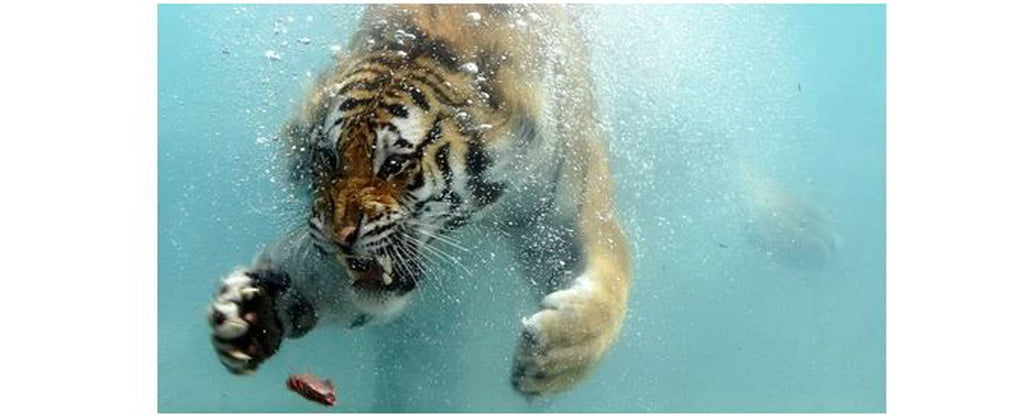
Unlike most animals, the tiger enjoys water; what it does not like is getting its head or eyes wet. That does not stop it from diving fully underwater when it wants to catch a piece of meat 🍖, a behavior observed in zoos that keep tigers.
Water also plays a vital role in the feeding behavior of these animals; after killing prey such as deer 🦌, cattle 🐃 or wild pigs 🐗, the tiger drags it into cover, preferably near water, before beginning to eat.
On hot days, the tiger may also lie in the water to cool off and drink. Some of our tiger shower curtains show tigers in the water at full height, such as a scene of tigers in a forest pool.

That's why the tiger prefers to stay near water while it feeds on its prey.

All the subspecies of tigers 🐅 are able to swim very long distances and can easily cross rivers up to about 8 km wide. Moreover, certain rivers have strong currents, which does not stop the tiger from crossing them when it wants to reach the other bank; clear proof that this striped cat is an excellent swimmer.

During the hunt, these large predators can even push their prey towards the water to use their swimming skills to capture and kill it more quickly, before the prey even has time to understand the ambush set up for it.
Tigers are territorial animals. Usually, they have a large territory, from about 10 square kilometers to more than 1,000 square kilometers. The male patrols his hunting area very regularly, marking it with his urine and his long, sharp claws to signal to other males that he is the master of the place.
To ensure that none of his fellow males have ventured into his territory, he takes shortcuts through the water to reach the places he wants during his patrol. Unfortunately, an encounter with one of them may trigger a bloody fight.
In India and Bangladesh, wildlife filmmakers have filmed 🎥 tigers regularly swimming from island to island to expand their hunting space and their territory.
The tiger is clever: thanks to its pronounced taste for water, it has refined its hunting techniques to obtain prey in any circumstances.
Its predatory instinct always takes over when it lives in the wild, making it very efficient when it starts hunting and pursuing its future victim.
The tiger will do almost anything to get food; even if it is not designed for fishing, it sometimes catches fish. How often that happens is covered in whether tigers really eat fish.

For many land animals, catching a fish 🐟 in a river is not an easy task, even less when the animal in question can weigh up to about 300 kg of muscle mass, with huge legs.
Usually, felines stand above the water, not knowing how to catch a fish, and usually hope to get one by pawing at random. Needless to say, this is not a very successful technique.
However, some tigers 🐅 have developed a well-elaborated and very efficient hunting technique. Tigresses later pass this very particular way of fishing on to their offspring.
This is the case of Bloody Mary, a Siberian tigress, observed by the famous writer Sooyong Park, known for his book "The Great Soul of Siberia" and his award-winning documentary, "Siberian Tiger Quest."
In his book, 📖 he describes the tigress as a great mother and an excellent hunter, showing remarkable intelligence.
When this tigress was fishing, she used a formidable technique: she gently approached the pond until three of her paws were entirely in the water, then stood still without moving a single ear.

Patient, she held this position for a very long time, until one of the Cyprinidae (freshwater fish family) started to come and eat the hairs on her paws, probably thinking that it must be algae.
It is at this very moment that she would administer a mighty paw strike to the fish 🐟 that was standing right in front of her, killing it at once or sometimes in two strikes.
Once the prey is in her mouth, the female tiger takes her catch back to her hungry cubs.

From their youngest age, tiger cubs living in the wild are constantly in contact with water due to their natural habitat. They grow up for the most part in wetlands such as marshes or forests hosting several water points, ponds, rivers.
Like their mother, they lie down in the water to refresh themselves, where they may play together and splash each other.
Indeed, play is an effective way to increase and acquire their hunting skills. For your own swims, a tiger beach towel for the sand brings the stripes to the water's edge.

However, they can play freely and without a care in the world 🌏, as the protective gaze of their mother constantly watches over them.
In time, the water will become familiar to them; they can then start learning to fish and move from one shore to another by swimming without any problems.

The tiger 🐅 is the largest of all felines; like some of its cousins, such as the jaguar, it is not bothered by water; quite the contrary, it readily adapts to its environment. As an excellent swimmer, it has far fewer limits than most cats.
Share your love for this huge cat by offering a soft tiger plush to your loved ones; the gift can spark a passion for the big cat.
That simple gesture also helps the message of awareness about the tiger reach more people in the future.