Your Cart is Empty


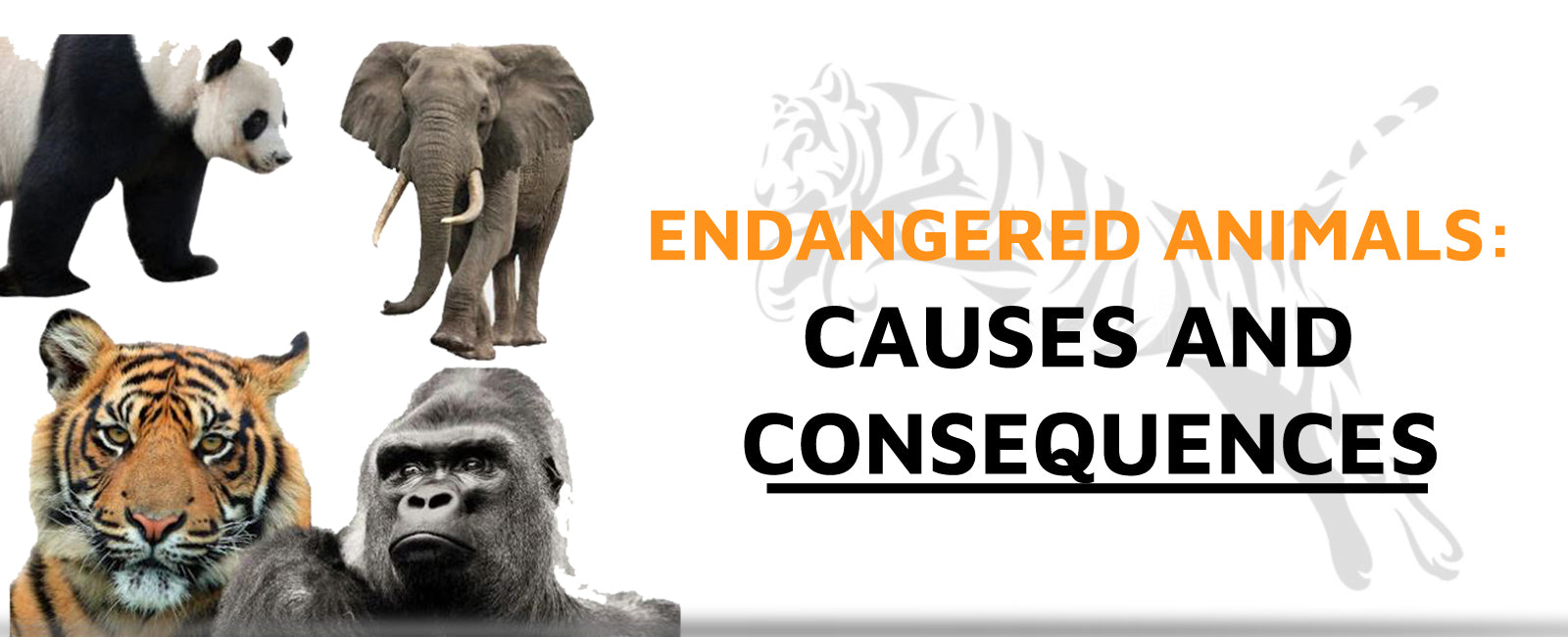

Most animals become endangered for two reasons, and both lead back to people. They are killed faster than they can breed, mainly through poaching and overfishing, and the places they live are cleared for timber, farmland, roads and mines. The consequences reach well beyond the species itself. When a large predator or a large plant eater disappears, the food chain beneath it shifts, habitats change and biodiversity grows poorer. Here is how that works, with five examples and ways to help.

Poaching means killing or capturing protected animals illegally, usually to sell their skins, bones, organs, tusks or meat. It is not the same as regulated hunting, which works within laws and quotas. Poachers have driven species toward extinction for centuries, and because animal parts fetch high prices on the black market, the trade keeps going even as penalties rise.
Those penalties are getting tougher. In India, crimes against the most protected species, such as the tiger, carry three to seven years in prison, and in 2013 Russia made trafficking in rare species such as the Amur tiger a criminal offense. Enforcement is the hard part. Protected areas are vast, patrols cost money, and as long as buyers keep paying, someone will be tempted to supply them.

The second great cause is quieter. Forests and grasslands are cleared for factories, farms and logging, and the animals that lived there end up on smaller and smaller patches of land until there is no longer enough prey, water or space to raise their young.
In the Russian Far East, logging companies are shrinking the forests of the Siberian tiger. Logging adds to the threat, though a long-term study of radio-collared Amur tigers found that poaching was still their leading cause of death. The two problems often travel together, because a new logging road also gives poachers a way into the forest.
Habitat loss is hard to stop because it is tied to income. Timber and farmland bring money to governments and companies, and protecting a forest means giving some of that up.
If you like to keep the big cat in sight every day, our tiger t-shirts carry it across the chest, from a small tiger head to prints that run from collar to hem.


The tiger has traditionally been divided into nine subspecies that once ranged across much of Asia. Three of them are already gone: the Bali tiger, the Caspian tiger and the Javan tiger. According to scientists, the South China tiger no longer exists in the wild. Since 2017 many specialists group the living tigers into just two subspecies, but the traditional names are still the easiest way to follow each population.
Not every tiger faces the same risk. The Bengal tiger is doing comparatively well, with a slightly increasing population, while the other surviving subspecies remain in a far more fragile position. The IUCN's 2022 assessment estimated 3,726 to 5,578 tigers in the wild. Tigers do breed in captivity, but a tiger in an enclosure plays no part in its forest's food chain, so captive numbers are no substitute for wild ones.

The giant panda became a worldwide emblem of nature conservation after its own crisis in China. As China's human population grew, roads, mines and farmland spread into the panda's range and pushed it into isolated mountain forests. Today there are about 1,800 pandas in the wild, far fewer than there were less than a century ago.
The panda also shows that protection works. The IUCN Red List moved the giant panda from Endangered to Vulnerable in 2016 as its numbers grew, and the species is now a national priority for China. China often lends pandas to other countries as a diplomatic gesture, and since 1984 it has loaned them rather than giving them as gifts. We compare the two animals in more detail in the tiger and the panda.

Gorillas get less attention than tigers or pandas, yet their situation is serious. These large African apes are poached for their meat, and young gorillas are captured to be sold illegally. The trade is forbidden, but monitoring is weak in many of the countries where gorillas live.
Both gorilla species, the western and the eastern gorilla, are listed as Critically Endangered on the IUCN Red List. A 2018 study estimated more than 360,000 western lowland gorillas, a number falling by 2.7 percent a year. The eastern gorilla is much rarer, with fewer than 7,000 Grauer's gorillas and more than 1,000 mountain gorillas left. Because gorillas are so close to humans, they also catch some of the same diseases, and Ebola has killed many gorillas in Congo and Gabon.

In the early 19th century, Africa may have had 13.5 to 27 million elephants, though such old estimates are very rough. Today there are about 415,000 elephants in Africa and only 40,000 to 50,000 in Asia, about 22,000 of them in India.
The elephant is the largest land animal on earth, and its tusks are what put it in danger. It is estimated that 25,000 elephants are killed each year so their ivory and skin can be sold on the black market. The situation in Asia is improving, but in many African countries poverty leaves few resources for anti-poaching work.

Sharks have lived in the oceans for hundreds of millions of years, and they may now be among the most threatened animals in the sea. Around 100 million sharks are killed every year. Most are not killed to protect swimmers or surfers. They are caught by intensive fishing, much of it driven by demand for shark fin soup, a traditional Chinese banquet dish.
In the practice known as finning, the fins are cut off and the rest of the shark is thrown back into the sea, where it sinks and dies slowly.

Large animals hold ecosystems together. Predators at the top of the food chain help regulate the animals below them, while the food supply also limits how many animals an area can support. Thanks to animals like the tiger, the number of deer and other plant eaters stays in balance with the vegetation they feed on.
Remove one of those pieces and the balance tips. Without the tiger, herbivores could increase sharply and overgraze their habitat, as elk did in Yellowstone after wolves disappeared. Every species plays a part in its ecosystem, so losing even one can ripple outward.
The deepest cost is poorer biodiversity. Scientists who study the subject find that an ecosystem rich in species and left undisturbed brings real benefits: it helps buffer some natural hazards and keeps a wide range of animal and plant resources available.
Children often start caring about wild animals through play. A tiger puzzle built from wildlife photography or East Asian painting reveals the animal piece by piece, and a soft tiger plush toy keeps a striped friend close at bedtime.


Many associations work to protect wild animals and the places they live, and many take volunteers. Through them you can help restore habitats for threatened species and take part in awareness campaigns that teach young people why natural environments matter.
If you cannot commit time, sharing an association's work and successes on social networks still helps and keeps friends and family informed.

Buying habits count too. A product from a company that destroys natural habitats indirectly funds that destruction, so it is worth finding out where things come from, especially wood and furniture, since some large brands play a significant role in deforestation. Wood carrying a recognized forestry label, such as FSC, is one simple place to start.
Never buy products made from protected species. Rugs, clothing and trinkets made from animal skins, ivory or shell feed the black market directly. For a tiger in the home, choose a sculpted one: our tiger figurines, most of them lifelike with sculpted fur and painted stripes, bring the animal indoors without harming a single one.

Economic reasons sit behind most extinctions. Poachers profit from fur, bones and tusks, and companies profit from clearing the land animals need. Tigers and pandas, two of Asia's best-known animals, have both suffered from deforestation and poaching, while gorillas, elephants and sharks face their own versions of the same pressures.
When these animals decline, whole forests, savannas and seas feel it, because the food chain loses one of its anchors. The encouraging part is that protection works when it is applied seriously, as the panda's recovery shows. Supporting conservation groups and choosing what you buy with care are both concrete steps.
To carry that reminder with you, our tiger rings put the animal on your hand in gold tones, silver tones and darker finishes.