Your Cart is Empty


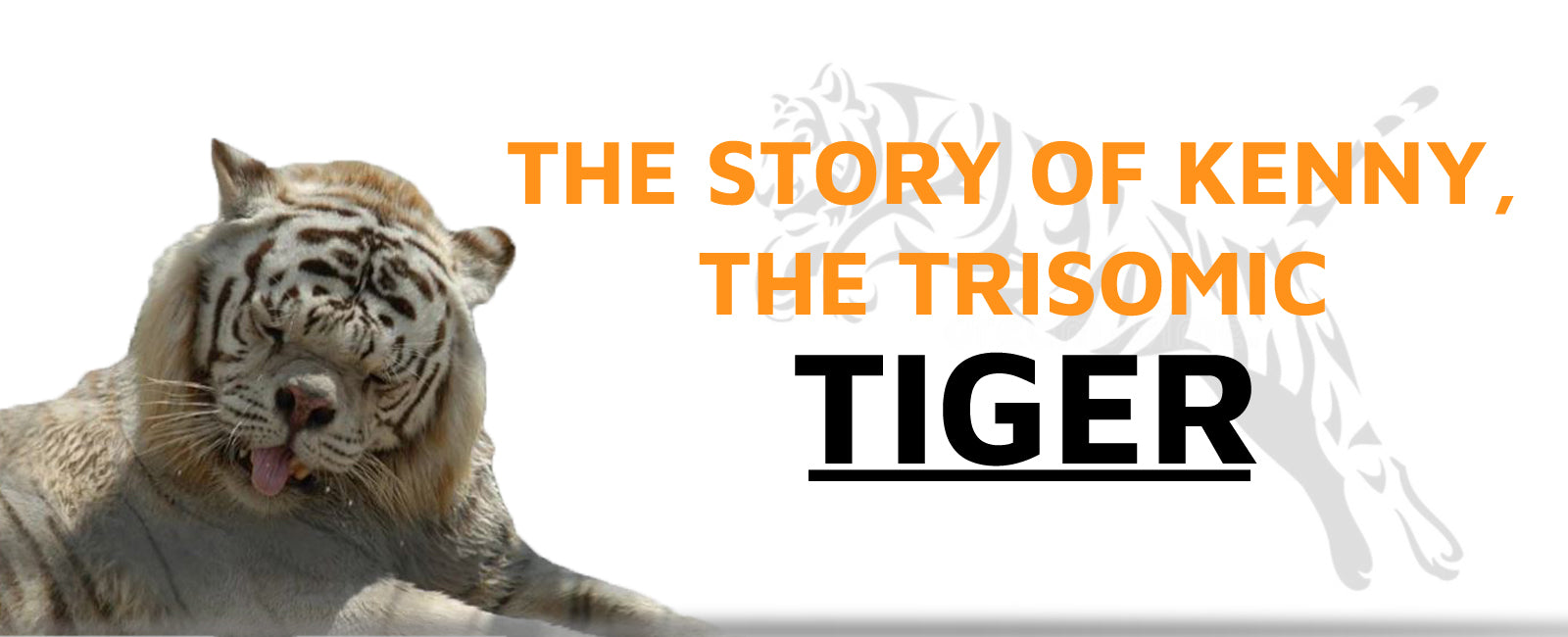

Just like humans, Tigers are subject to all sorts of genetic malformations. In the best of cases, these handicaps are very slight and are not even noticeable to the naked eye. However, some species of animals are more severely affected by genetic diseases. This is the case of Kenny, a white tiger whose facial deformities came from inbreeding.
Kenny drew wide media coverage because of the many malformations he suffered from. He became the symbol of the fight for genetic diversity for animals in captivity. These anomalies are not specific to White Tigers and have already affected many other species, like Kanako, the chimpanzee.
The general public still knows relatively little about this sad subject. Zoological parks prefer to keep this kind of problem quiet to avoid scandals. But it is essential to talk about it to find solutions that will ensure the sustainability of species in captivity.
That is why today, we will tell you the story of Kenny, the white tiger wrongly called the "Down Syndrome Tiger". We will also explain the different problems that all White Tigers are facing.

As said before, Kenny has become a true international star. Born from brother and sister parents, he had many deformities in his face, which explains his nickname of "Trisomic Tiger." His muzzle and his mouth were badly deformed, which prevented him from closing his mouth. Because of this, Kenny drooled a lot, which makes his disease even more apparent.
This poor Tiger was born in 1998 in the United States, in Bentonville, in the far northwest of Arkansas. A tiger breeder planned his birth by mating two of his tigers, a brother and sister. His goal was to get a white tiger cub to sell at a good price. However, the inbreeding produced a cub with severe facial deformities: Kenny.
In addition to his facial deformities, the young tiger had motor problems that prevented him from moving with ease. However, the refuge that cared for him never found any mental disability. Surprisingly, his brother Willie looked like a classic Bengal Tiger. His coat was quite traditional, and he had no physical deformities, although he was affected by acute strabismus.
Carry the image of the white tiger on your phone with our Tiger Phone Cases. ⤵️

Because of their peculiarities, the owner of the 2 Tigers could not sell them for a good price. So, although his intentions were very questionable, he at least had the decency to entrust them to a Tiger Reserve. The two brothers joined a refuge called Turpentine Creek in Arkansas.
They adapted very quickly to their new environment and the staff of the refuge. The 2 Tigers became the darlings of the visitors and, in particular, Kenny! One would have expected people to be hostile to the Tiger's deformities, but the exact opposite happened.
Unfortunately, Kenny and his brother would not live long. Kenny died in 2008 at the age of 10, and Willie 2 years later at 12. It was a somewhat predictable thing considering the genetic heritage of the 2 Tigers. As a reminder, tigers in captivity typically live about 16 to 18 years, and a few live past 20.

Kenny did not have Down syndrome, but he was above all a White Tiger. This particularity is not insignificant because White Tigers are much more affected by genetic anomalies. Contrary to popular belief, the White Tiger is not a subspecies in its own right, but simply a Bengal Tiger with a rare mutation. Indeed, it carries a recessive allele that removes most of the red and yellow pigment (pheomelanin) from its fur, while the black pigment of its stripes remains. This phenomenon gives them the white pigmentation so characteristic of their fur. That pale coat with dark stripes also appears in our tiger figurine collection, which includes white tigers with brown or black stripes.
So-called tiger trisomy is not a trisomy at all, because Kenny did not have any extra or missing chromosomes. However, he was a carrier of a recessive gene which caused him to have this genetic mutation. All White Tigers carry this gene and pass it on to their descendants. This is why the coloring of these Tigers is passed on from generation to generation.
However, it is essential to specify that white Tigers do not have albinism. Their genome allows them to have black stripes, which is impossible in albino Tigers. An albino tiger would be entirely white, with pink eyes. Our guide to every tiger coat color explains how white and golden coats arise.
Nevertheless, it seems essential to us to make people aware that Kenny or any other animal called "trisomic" does not have his malformations from animal abuse. Their deformities are genetic, but they come from deliberate inbreeding by breeders, not from the veterinarians or zookeepers who care for them. They only care for these animals as best they can to give them the best life possible.
The existence of the White Tiger results from a genetic anomaly, but why would it be more sensitive to deformities? In reality, the answer is simple: White tigers in captivity are more fragile because they are highly inbred, and this inbreeding causes health problems in many of these white tigers. That's why we observe so many problems in this population of Tigers.
But another element makes these health problems even more common in this line of Tigers. We will look at it in the next part. And if you want to learn more about the White Tiger, you can read our dedicated article.

The main problem behind deformities like Kenny's is inbreeding. Most white tigers in captivity descend from Mohan, a white male captured in India in 1951, who was bred with his own daughter. As a result, captive white tigers are closely related, which makes the whole population inbred and prone to many malformations, such as crossed eyes and facial deformities.
Unfortunately, this problem is not about to stop. Because all these Tigers descend from a few closely related animals, the population is highly inbred. This makes it impossible to create a new lineage, which would solve the problem entirely. To this day, science has still not found a solution. Even genetics cannot work miracles yet.
A few figures attest to this genetic impoverishment: 80% of White Tigers die at birth or soon after because of inbreeding. The female has many miscarriages before giving birth to viable babies. The remaining 20% suffer from many problems, such as strabismus, impaired vision, heart defects, or spinal and facial deformities.
The animal welfare group Big Cat Rescue has estimated that only about 1 in 30 white tiger cubs survives without major deformities. Thus, we are condemned to see the genes of these animals getting poorer and poorer. Kenny did not have Down syndrome, but he is certainly not the last white tiger deformed by inbreeding. It would not be surprising to see another Tiger with a pathology similar to his in a few years.
Keep the white tiger close to you with our WHITE TIGER PENDANT ⤵️


As we said in the introduction, tigers are not the only animals with genetic anomalies. Chimpanzees can be born with an extra copy of the chromosome that matches human chromosome 21, but cats, including lions and tigers, cannot have Down syndrome.
If you look carefully at the pictures, you can see that these poor animals have facial deformities, which in Kenny's case came from inbreeding. We can see that it is characterized by a deformation of the muzzle and an abnormally high spacing of the eyes. Sometimes, it is possible that a malformation at the level of the mouth prevents the animal from closing it, as was the case with Kenny.
This part shows that all animals are susceptible to genetic problems. These phenomena are not specific to humans or tigers but affect all species!
Kenny is not an exception: many captive white tigers suffer from the effects of inbreeding. These handicaps make life very hard for these animals, which is why zoos try to take care of them the best they can. Zoos accredited by the Association of Zoos and Aquariums stopped the inbreeding used to produce white tigers in 2011, because it causes serious health problems.
It is important to open our eyes to the current situation of the White Tiger in order to avoid further genetic damage, because the condition of these animals will not improve with time. The future of this lineage is very controversial, and we even wonder if it would not be wiser to prevent any reproduction.
This could be a solution, since white tigers are a color variant, not a species, and the last known wild one was shot in 1958. Forcing an extinction by preventing mating would allow us to spare future White Tigers from a painful and difficult life. Whatever the case, the priority remains to treat with as much love as possible these animals that embody the beauty as well as the cruelty of nature. Their beauty can also live on in art, like the white tigers among the many scenes of our tiger canvas collection.
Feel free to tell us what you think in the comments, and we will be happy to answer you.