Your Cart is Empty


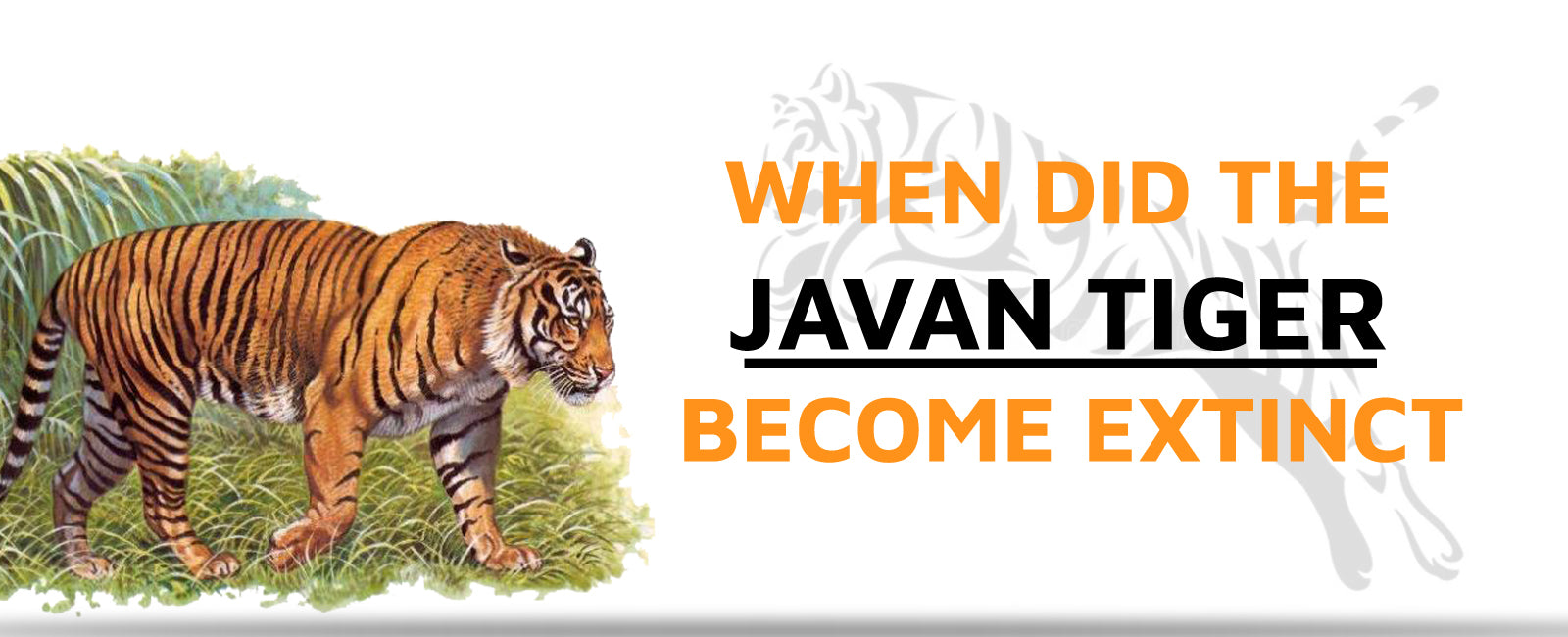

As mythical as it is misunderstood, the Java Tiger remains a legendary animal for all fans of the striped big cat. Now considered extinct, the species continues to make headlines in Indonesia.
The Java Tiger (Panthera tigris sondaica) is one of the nine subspecies of the Tiger that lived only on Java, Indonesia. Its extinction in the 1970s was officially recognized at the beginning of the 21st century. Very little is known about the behavior and lifestyle of this Tiger.
That's why Tiger-Universe has gathered here what is known about this mysterious species. Java is an island full of secrets of all kinds; the Java Tiger is perhaps the most mystical.

The Java Tiger is an extraordinary cat. First of all, it is small compared to other Tigers. Its length of about 2.5 meters for males makes it one of the smallest tigers, although the neighboring Bali Tiger was smaller still. Its coat is short and thin, suited to the high temperatures of the island. It also has fine, narrow black stripes, so it is easily confused with the Sumatran Tiger, which it closely resembles.
In addition to its relatively small length, the Java Tiger has a skull size between 30 and 35 cm with a weight between 100 and 140 kg for the largest. Knowing that a Bengal Tiger weighs on average between 200 and 250kg, we quickly realize the small size that the Java Tiger has. Moreover, its skull is very elongated, which gives it a physique very similar to a large fox or even a leopard.
Unfortunately, only a few pictures of this tiger can accurately attest to this description. The images taken at the time are in black and white and of rather poor quality. Museum skulls show that island tigers, the Java Tiger among them, usually had shorter canines than mainland tigers.
The small size of the Java Tiger can be explained by the absence of large prey on its territory. Indeed, in Java, the herbivores are much smaller than in India. Tigers have therefore adapted to scarcer game by reducing their body mass over time. The size of the tiger is also explained by the high temperatures on the island, which made it lighter over time, because a small animal regulates its body temperature more easily in a warm place than a large, heavy animal does.
This is called Bergmann's rule, and it explains why the closer we get to the tropics, the more animals tend to reduce in size. Animals in cold places are bigger to keep the heat in their bodies as much as possible.

The Java Tiger feeds on smaller species than other tigers, such as rusa deer, small wild boars, or some reptiles. It falls back on small prey when it does not find herbivores on its territory.
This species was endemic to Java, meaning that it lived only in Java and nowhere else. This habitat was not very well suited to the tiger's life; the heavy rains and the absence of large deer did not favor its survival.
Tigers most likely reached Java over land bridges that linked it to the Asian mainland when sea levels were low during the Ice Ages. When rising seas flooded these land bridges, some Tigers were trapped on Java, an island that is part of the Indonesian archipelago. Hence the existence of the Java Tiger on the island.
Honor this extinct species with our Tiger Caps. ⤵️

At the end of the 1700s, the Tigers of Java were present on a large part of the island. They occupied the forests uninhabited by man, which constituted more than 80% of the land. In 1820, the Tigers became more and more numerous on Java, so much so that they started to become a danger to humans and livestock.
But this new danger was not due to too large a population of Tigers. It came instead from the massive deforestation that was taking place on the island, which destroyed the habitat of many species that the Tiger used to feed on. As the Tiger could no longer find food in its environment, it began to attack livestock and humans.
Between 1810 and 1870, there were many tiger attacks, and they became more and more deadly. However, some of these accounts were copied or embellished to keep the public interested.
But in 1822, the Dutch colonial government employed professional hunters to kill Tigers for the first time. Between 1830 and 1860, about 1,250 Tigers and leopards were killed each year. For their part, Javan Tigers were held responsible for 120 deaths per year.

In the early 1900s, to feed a growing population, forest areas were increasingly exploited. This destroyed the Tiger's habitat and made its territory much too small for it to live in peace.
In this way, the population fell drastically, until it reached the critical number of 200 Tigers in 1940. Hunting, poaching, and competition with the Java Leopard, which was much better adapted to this environment, put the striped cat in great danger of extinction.
In 1960, only a few Tigers still managed to survive, as best they could, on tiny patches of land. However, its situation continued to deteriorate, and in 1971, an old female was shot near Mount Betiri, and in 1976 tracks showed that three to five tigers still survived there. In the 20 years following its disappearance, searches were carried out. A few footprints and traces of the Tiger were found, but no concrete evidence of its survival. Never again will a Javan tiger be officially observed. In 2003, the species was considered extinct by the IUCN.
Other studies continued to be carried out after this date. Cameras were installed for one year in the southeast of the island, in Meru Betiri National Park, East Java. Unfortunately, none of them filmed a Javan Tiger. The species seems to be extinct for good, to the great sadnessof everyone who admires the tiger.

The rumors about the disappearance of the Java Tiger are many and varied. First of all, many witnesses claim to have seen the tiger in the heart of the island. But these people who say they have seen it never bring concrete evidence, but only statements.
In 2017, a video circulating on the web seemed to show a Java Tiger in its natural environment. Experts looked at the footage and demonstrated that this "Tiger" was, in fact, a Javanese leopard. The image quality was so poor that people thought it was the return of the Javan Tiger.
Moreover, the people reporting to have seen the big cat on Java may not have been lying. However, nothing shows that these cats were tigers, let alone Javan tigers, although it remains possible that tigers of another subspecies were released there illegally.

The Javanese culture gives the Java Tiger a special place. Tradition holds that the Tiger has a human spirit. In other words, man and the big cat would share a common ancestor.
The Tiger was initially a vegetarian, but one day the man prepared a meal and accidentally cut his finger. The finger fell into his dish, and the tiger ate meat for the very first time. It is by tasting the flesh that he became a wild animal.
Other legendary stories tell that after fasting and meditating for 40 days in a forest cave, the Java Tiger acquires magical powers. These powers would allow him to become completely invisible in the jungle. But once a man sees it, he would have to take another 40 days to regain his powers.
Among shamans, the Javanese Tiger is considered the protector of sorcerers who contact the forest and the elders. Moreover, the guardian spirits of Indonesian villages were believed to appear in the form of a big tiger and to protect those who prayed to them. On the other hand, they would take the form of a gigantic Black Tiger to terrorize all those who harm the forest's soul. This guardian role is shared by the tiger in much of Asia, and a tiger statue is still a classic way to give it a place in the home.

Like many other species, the Javan tiger has become extinct due to human neglect. Urban populations entirely ignored this unique animal before its disappearance. It is becoming more and more urgent to open our eyes to the dangers faced by certain animals. When a species disappears, it is a part of our heritage that goes up in smoke.
The island of Java continues today to pay tribute to this extinct Tiger with many legends. They maintain the mystery around the striped animal and the potential existence of the last specimen. Unfortunately, all the elements indicate that this tiger is extinct.
The least we can do is to remember this Tiger and continue to honor it. A lifelike tiger figurine on a shelf is one small way to keep the animal in view. Only by remembering can we learn from our past mistakes so that we don't make the same ones in the future. The future is more than uncertain for Tigers around the world. Today, we must become aware if we want to avoid seeing new species become extinct, like the South China Tiger, which is currently in great danger.
"It is a sad thing to think that nature speaks to us and that the human race does not listen."
Victor Hugo
Decorate your home with our Tiger Rugs, made in the image of the great striped cat.⤵️