Your Cart is Empty



The Chinese Tiger is at the center of many mysteries and questions. The image of this legendary animal still inspires astrologers today. This can be seen through the various myths that revolve around the animal and its zodiac sign.
Indeed, whether it is on a cultural, philosophical, or even political level, the influence of the tiger is felt throughout Asia. A long-standing symbol of power and ambition, the aura of the Tiger has allowed the greatest Empires to be born and fully assume their domination. You will see that its personality and its way of hunting contributed enormously to the development of strategic and military techniques.
Beyond the symbol, the Chinese Tiger is also an actual animal, a tiger subspecies better known as the South China Tiger, and it faces many problems. So, in addition to talking about the cultural aspect, we will also talk about the real dangers it faces in China.
If you are here, you probably want to learn a little more about the place of the Tiger in China. After reading this article, you will know the many factors that have played in favor of its popularity and its international influence.
Let's enter the heart of the Middle Kingdom and meet its most emblematic predator.

China is a very ancient nation that has seen a number of very different dynasties. This country with a rich and priceless culture is a land that has seen some of the most beautiful animal species in the world evolve.
In the ancient Chinese Empire, the first traces of cohabitation between Man and the Great Tiger can be found. Local populations very quickly devoted a cult to the tiger because they had never before seen a beast of such splendor. Its power led them to call it the King of the mountain or the God of the jungle.
This earned it a sacred place in Chinese mythology, alongside the Dragon. Moreover, these two creatures are often opposed in ancient representations and writings. The symbol of Yin and Yang is a perfect example because this balance of forces is usually translated by a perpetual confrontation between the Tiger (Yin) and the Dragon (Yang).
In addition to mythology, the significance of the Tiger has had a significant impact on its popularity and status as a sacred animal. In China, the big cat symbolizes justice and respect for ancient traditions, which is why the Year of the Tiger, which comes around every 12 years, matters so much to the people. The population has a deep admiration for this sacred animal, a witness of natural power. In the same spirit, the tiger is still seen as a guardian figure, and a Chinese tiger statue set on rock or pine is a traditional way to give it a place at home. Our article on the tiger in feng shui explains where such a statue is believed to belong.
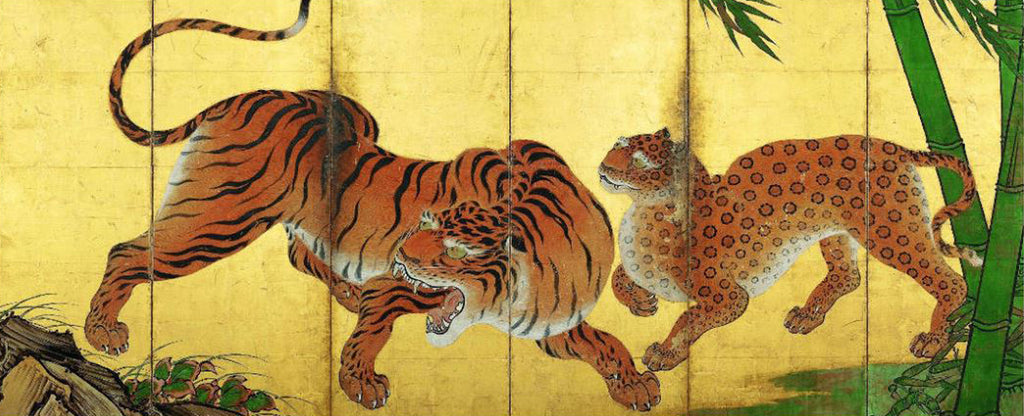
This admiration can be felt through the numerous artistic representations of the image of the Tiger. There are countless paintings, scrolls, frescoes, and porcelains expressing the enchanting beauty of its silhouette. Many of these creations show a finesse and quality that few other civilizations matched.
As an aside, Western collectors paid high prices to acquire these artistic masterpieces.
Even the old emperors wanted the walls of the temples and the streets of the cities to be decorated with paintings in the effigy of the Tiger. All this was to express the grandeur and ambition of their Empire. Traces of these cities entirely painted in honor of the Tiger are present in some writings of ancient literature. Even today, Chinese temples proudly bear the image of the Tiger on their doors as a symbol of ancestral royalty. Painted tigers still hang in many homes today, and our tiger canvas prints include designs drawn from Asian and Indian painting traditions.
But if we were to choose one area where the mere presence of the Tiger was enough to revolutionize traditions completely, it would be war.
The Tiger served as an inspiration for many Chinese military generals. Sun Tzu's "The Art of War" is a classic book recognized worldwide for its relevance and insight into warfare, although the text itself never mentions the tiger.


The Fire Tiger is a mythical animal of the zodiac and astrology. It occupies the 3rd place in the Chinese sexagesimal cycle (60 years) and is full of meanings.
Fire Tigers include people born between February 13, 1926 and February 1, 1927, or between February 9, 1986 and January 28, 1987. Their lucky numbers are 3 and 9, while their lucky colors are green and golden yellow. In tradition, Fire is the 2nd branch of the five primary elements.
But what about its influence on human personality and behavior?
In Chinese astrology, Fire Tigers are said to be naturally intelligent, quick-witted, and very wise people. They love to read and are attracted to enriching cultural activities from an early age. Honesty and seriousness are the two founding pillars of their personality, as no matter what the situation, they will always fully express their opinions.
On the other hand, they can also be overly proud and eager to earn the admiration of others. In their search for attention, this trait can lead them to make fools of themselves without even realizing it.
If you want to know more about this symbol, we invite you to read our complete article on the Fire Tiger.

The Wooden Tiger is much less famous than its fiery cousin. Even so, astrologers say it has a strong influence over those born under its sign. It is found in the 51st place of the 60-year cycle of the Chinese calendar.
To be a Wood Tiger, you must have been born between January 23, 1974 and February 10, 1975, or, for the oldest, between January 26, 1914 and February 13, 1915. Their lucky numbers are 2 and 7, while green and brown are their favorite colors. Wood comes in 1st place in the theory of the five primary elements.
Does the power of this animal affect people's lives?
According to Chinese astrology, it does, and if you are a Wood Tiger, you may recognize yourself in this description. Individuals of this sign are naturally strong, courageous, but above all independent. They love to do things themselves and enjoy being helpful to others. Loyalty is paramount with them, and when they give their word, they always keep it.
Despite this, they can sometimes be selfish and think only of themselves. On top of that, Wood Tigers find it hard to admire other people, even when those people do great things.
To learn more about this animal, we invite you to read our full article on the Wood Tiger.

The Metal Tiger is very popular in Chinese astrology because of its unique temperament. It is located at the 27th place in the great Chinese calendar, between the earth buffalo and the metal hare.
Metal Tigers are born between February 17, 1950 and February 5, 1951, or, for the youngest, between February 14, 2010 and February 2, 2011. Their lucky numbers are 1, 3, and 4, and their lucky colors are blue, grey, and white. In the 4th position, we find metal in the theory of the five sacred elements.
What about the character of the Metal Tigers?
These people are very popular with those around them because of their cheerful and always enthusiastic personality. These Tigers are independent enough not to need the help of others all the time. They love to live in a quiet place, far from the noise of big cities. Finally, family is the most important thing in the world to them, and they will do their best to take care of it.
On the other hand, these Metal Tigers are very emotional and are often guided by their feelings. They are very sensitive to mood swings and often lack patience. People of this sign have to control themselves if they want to be happy.
Learn more about the Chinese zodiac by reading our full article on the Metal Tiger.

The Earth Tiger has established itself in the Chinese culture thanks to the multiple facets of its personality. It is at the 15th place in the Chinese sexagesimal cycle and symbolizes the opposition between Yin and Yang.
If you were born between January 31, 1938 and February 18, 1939, or between January 28, 1998 and February 15, 1999, you are an Earth Tiger. According to astrology, your lucky numbers are 3 and 9, while your lucky colors are brown and gold. In addition, Chinese five elements theory places Earth as the 3rd fundamental element behind the existence of the universe.
However, what are the character traits of the Earth Tiger?
According to Chinese astrology, this animal brings an unerring sense of justice to people of its sign. Indeed, Earth Tigers are constantly fighting against injustices in the world. In addition, they work hard to achieve projects that are important to them. They are confident and adventurous, two qualities that are said to help them reach any dream as long as they stay motivated.
Even though they are very good people, they are not immune to some flaws. Earth Tigers can be impatient and angry. These personality traits often lead them to make mistakes. In addition, they hate to follow the rules, so they can get into a lot of trouble without even realizing it.
You will find the origins and a complete description of this elemental animal in our article dedicated to the Earth Tiger.

We finish with the element most appreciated by the sages: water. The ancients admired the Water Tiger for its calm and impassive temperament. It is found at the 39th position in the 60-year cycle of the Chinese calendar.
Water Tigers include people born between February 5, 1962 and January 24, 1963, or between February 1, 2022 and January 21, 2023, the most recent Water Tiger year. Their favorite numbers are 2 and 8, while blue and green are their favorite colors. Water is the last of the five elements that, in this theory, lie at the origin of the world.
Let's see what attraction the Water Tiger holds for people.
As we told you before, this symbol is reflected by a calm and cautious character in people of this sign. Water Tigers have a constant thirst for knowledge as their highest goal is to understand the world around them. They also have a deep respect for the vastness of nature.
On the other hand, they often have too high an esteem for themselves. Therefore, even if they realize their mistakes, they find it very hard to own up to them. Water Tigers need to rethink their view of themselves if they want to grow.
Finally, you can study this sign in more depth by reading our complete article on the Water Tiger.

Also known as the South China Tiger or Panthera tigris amoyensis, the Chinese Tiger is a tiger subspecies, which a 2018 genome study found distinct from the other living subspecies. It is native to the province of Fujian and its surroundings in southern China. A 1987 study described it as a relict population of the ancestral "stem" tiger.
From a physical perspective, the Chinese Tiger is not so different from its famous cousin, the Bengal Tiger, but specific physical characteristics can still identify it. The latter mainly concern its skull and its fur.
Indeed, its skull is shorter and less imposing than that of the Indian Tiger. Its coat also differs: it is a more orange color, and its stripes form a pattern of their own across the whole body. In addition, a male specimen of this species measures between 2 and 2.7 meters in adulthood for a weight oscillating between 120 and 180 kg. Bengal Tigers are therefore slightly longer and heavier than Chinese Tigers.
This small statue captures all the grace of the Chinese Tiger.

You will surely have understood that the Tiger's presence in the Chinese culture is mainly due to the existence of this animal on these lands. Some villages have fully lived alongside the Tigers throughout history, thus forging its reputation. Simply observing this great cat and its impressive physique up close was enough for it to become definitively established in the minds of the populations.
Before the 1940s, it was not uncommon for villagers to see tigers wandering on their land searching for prey. These animals were widespread across Southern China and, more broadly, across Asia.
But this era is now over, and the next section explains why.

Unfortunately, after the Second World War, the population of Chinese Tigers decreased sharply throughout the country. This decline is explained by government anti-pest campaigns that began in the early 1950s and by the Great Leap Forward, the commune and industrial production campaign Mao Zedong launched in 1958. In 1959, Mao Zedong declared South China tigers enemies of man and encouraged campaigns to exterminate them.
Mass killings followed throughout the south of the country to eradicate this animal considered "dangerous." In addition, deforestation was caused by the massive industrialization of the country after the 1950s. This destroyed the habitat of the Tiger and drastically reduced the number of prey to hunt.
As you can imagine, these two events had disastrous repercussions on the species.
So much so that today, there are no longer any South China Tigers in the wild. Nevertheless, more than 200 individuals currently live in captivity. These numbers are disturbing when you consider that these animals populated a large part of China before the 19th century. This makes the Chinese Tiger one of the most endangered animal species globally. Our article on when the South China Tiger became endangered follows this decline in more detail.
But another phenomenon has hastened the fall of the beastwhile also adding to its popularity. That is the subject of this last part.

Asian medicine traditionally uses natural elements to treat diseases and severe pain. Thus in this field, the organs and bones of the Tiger play a central role thanks to their "supposed" healing power. Even if these virtues are not scientifically recognized, many Chinese believe in them and therefore indirectly encourage poaching and slaughter of Tigers.
Chinese medicine gives the big cat a central place, one it could easily do without.
In the 20th century, tigers across Asia, not only Chinese Tigers, fell victim to this traffic. Today, illegal hunting threatens several tiger subspecies, such as the Siberian Tiger or the Indochinese Tiger. Without forgetting that other animals are also exposed to this practice, such as the panda or the rhinoceros, to name but a few.

The love of local people for this ancient tradition has not diminished in recent years. On the contrary, this practice has been growing in popularity lately for a straightforward reason. Because Chinese medicine is more than 3000 years old, it is considered a great source of authority among the populations.
If we were to take a positive note from this unfortunate situation, we could say that traditional medicine has contributed enormously to the popularity of the Tiger in China. The massive importation of bones, furs, and organs has brought this big cat to the attention of people living in big cities. In this way, it is easy to understand how Chinese medicine managed to popularize the Tiger while creating a real underground black market.
It is unfortunate to see that tigers continue to die because of this trade, and seizures of tigers and tiger parts from 2000 to 2022 averaged about 150 tigers a year.

To recapitulate all that has been said, the tremendous popularity of the Chinese Tiger depends on various factors and their time. As you can probably imagine, the reputation of the Chinese Tiger did not develop overnight. The whole history has contributed and still contributes to the image of the Tiger.
The first thing that has contributed to this is, of course, the fact that it very quickly became a sacred animal. The old sages were so struck by the complexity and temperament of the Tiger that they quickly raised it to the highest rank. This led some populations to regard it as a divinity. For them, the tremendous strength of this hunter was clear proof that nature is made to dominate Man.
The second event is directly linked to the first. Because by becoming a sacred animal, the Tiger also entered the Chinese calendar. This allowed it to be symbolically divided into five elements such as fire, wood, metal, earth, and water. Thus, these 5 Tigers are all part of the Chinese cycle of 60 years. Each of them is believed to influence the personality of people born in its years. If one of those years is yours, a Year of the Tiger pendant with a zodiac wheel is a discreet way to wear your sign.

But the first two facts would surely never have come to light if the big cat did not exist in China itself. Indeed, the South China Tiger is the species that is described in ancient porcelains and scrolls. The popularity of the Chinese tiger is due to this animal, which is in great danger of extinction.
Thanks to this article, you have learned a great deal about this Oriental creature. You now know how the great beast has inspired and influenced the Chinese way of life.
To bring a little of this culture home, take a look at our Tiger Cushion Covers, inspired by an animal seen as a symbol of purity across China.